
Consumers today enjoy a plethora of options to pay for goods and services online. Yet while the interface of online payments might seem basic to the end user, the online payments ecosystem is an ever-growing sphere. As money changes hands from customer to merchant, card networks, payment acquirers, alternative payment method providers, and many other players involved in the processing of online payments are communicating in a harmonious, behind-the-scenes dance that ensures the performance and continuous flow of transactions.
With transactions becoming more global and with more of them taking place online merchants must keep up with this complex playground – particularly the ins and outs of regulations and compliance requirements – all while trying to ensure the performance of their payment stack and make it as efficient as possible.
The following page outlines the individual role of every player in the online payment processing ecosystem, which ones are linked to your payment stack directly, and where each piece of the puzzle fits within the overall flow of online payments. Lastly, we explore where PayU comes into the equation and how we can help you maximize the efficiency of your online payments.
The lifecycle of a transaction on its way to authorization starts with the user’s intent to purchase goods or services. In the user’s experience, the entire process lasts no more than a few seconds, yet the story behind the curtain involves multiple stages and each stage can impact the possibility of a transaction being approved or declined.
Online payment processing differs from ‘regular’ payment processing mainly in that online transactions are often performed between a consumer and a merchant which are placed in different geographical locations, and therefore the consumer’s identity cannot be verified by the merchant physically. This gap creates an added layer of complexity of online payment processing in comparison to POS (point-of-sale) transactions.
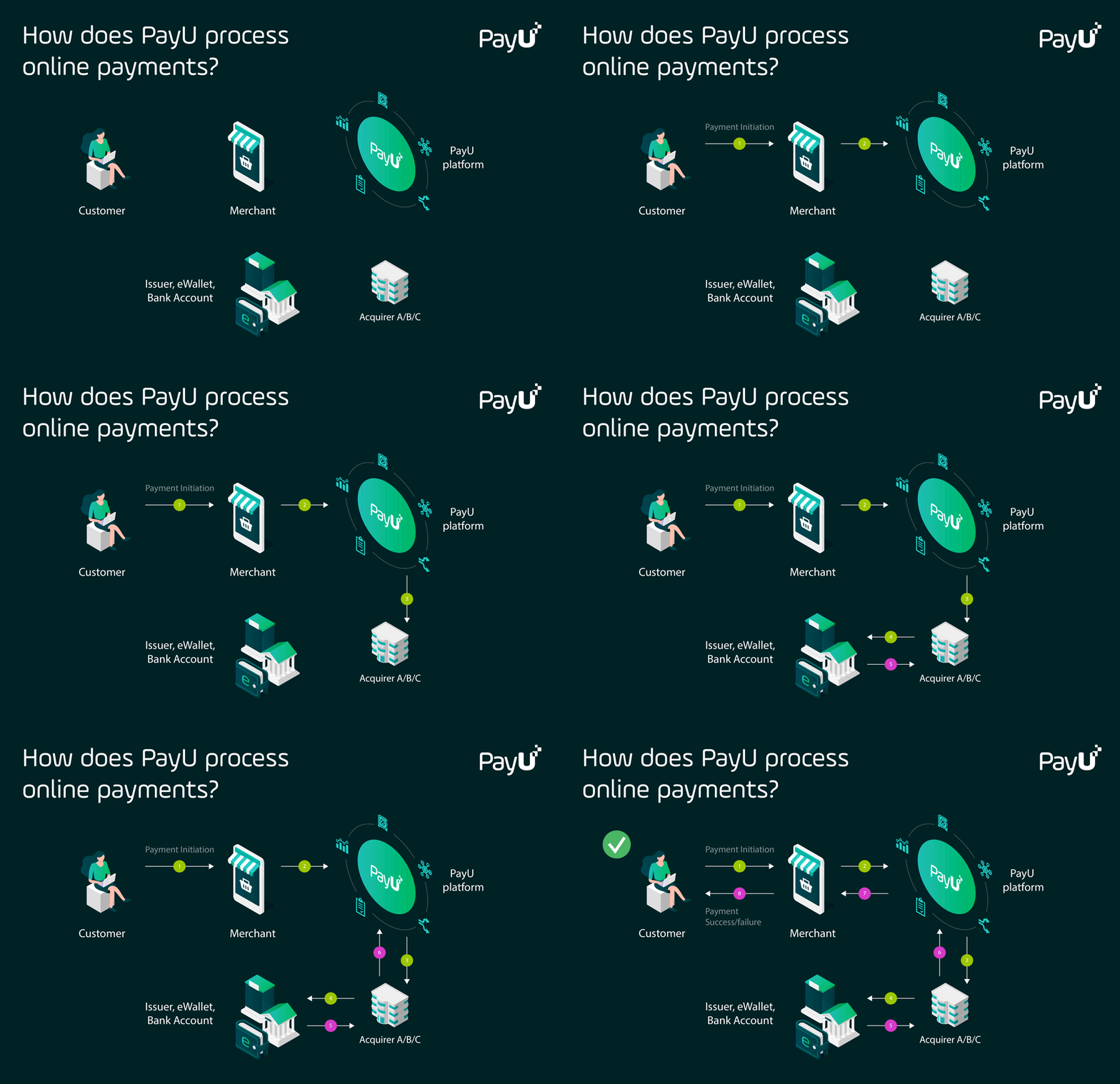
If we simplify the process to its core, each online payment consists of the user, merchant, and the payment processing solutions that the merchant needs to interact with in order to approve/decline the transaction. In order to get paid, merchants need to integrate with a bank/payment acquirer whose job it is to hold on to the user’s payment on the merchant’s behalf –eventually depositing the funds into the merchant account once the transaction is authorized.
In addition to these basics, there are further players that help maintain the flow of sending and receiving payments. The payment processor is a service that works directly with the banks and card issuers, as well as any alternative payment methods. The payment gateway, meanwhile, links the shopping cart on your website to the payment processing network. Many payment services providers, including PayU, function as both a payment processor and a payment gateway.
Regardless of the level of integration along the way, all of the above players communicate with each other and in an optimal scenario the transaction is processed successfully without the user (or merchant) paying much attention. Yet as with most aspects of e-commerce, money is made and lost along the margins. This creates a plethora of opportunities for optimizing the payment flow, which helps merchants grow their customers and increase sales through the simple act of increasing the number of payments which are processed successfully.
One of the biggest scourges for any merchant accepting online payments is that of ‘false declines’ – transactions which should not have any reason to be declined but are declined anyway, generally because they trigger one of many possible fraud filters which are typically determined by an algorithm.
There are many reasons for fraud filters to raise a red flag and trigger a false decline, from the shopper’s IP location, to the value of the transaction, to inconsistencies between the shipping and billing addresses (plus many more).
One of the ways that payment processors can help merchants to maximize the value of their online transactions is through solutions like PayU’s Instant Retry Feature, which allows merchants to configure their own set of custom routing rules that can attempt payments again in real-time using a different payment acquirer, in the event that a transaction is declined by the first provider.
PayU has a footprint in online payment processing offering both an acquiring service (as a Payment Services Provider or PSP), as well as an advanced payment gateway.
On the front end, PayU allows merchants to offer customers a full slate of popular local, global, and alternative payment methods tailored to the needs of local markets. At the back end, our platform’s advanced AI capabilities are designed to optimize payment approval rates and minimize fees.
PayU also takes care of fortifying your payments and keeping them compliant with all regulatory requirements.
Card networks are card brands such as Visa, Mastercard, American Express, etc., which have a regulatory role in the payment ecosystem, helping to oversee the flow of transactions performed by users while maintaining industry standards for security and regulatory compliance.
Issuers are entities that issue credit and debit cards to consumers on behalf of the card networks (e.g. Visa, Mastercard). The issuers are usually banks, but not necessarily. Since issuers are the ones who assume risk if a customer is unable to pay, the authorization process cannot be complete without their assurance that the customer has the funds to pay for the transaction.
Also known as acquiring banks, payment acquirers play a key role in payment processing. The acquiring bank helps the merchant “acquire” the funds that the buyer has committed by processing transaction information and sharing it with the card networks/alternative payment method, in order to complete the payment.
A chargeback is a payment that is reversed by the issuing bank on behalf of the buyer. Generally chargebacks take place due to a) a customer returning a purchased item; or b) a transaction dispute by the buyer/cardholder.
CNP stands for Card-Not-Present. It refers to any transaction where the merchant and buyer are not in the same physical place. Examples of CNP transactions include online purchases, recurring payments, orders made over the phone, or invoices that are paid online.
A cross-border payment is any payment performed between accounts in different countries. Cross-border payments are typically more complex to process than domestic payments, because of the need to coordinate between a wider range of financial participants. Without the use of appropriate payment optimization technology, this can result in lower approval rates, higher costs, or both.
A credit card chargeback refers to any chargeback where the buyer uses a credit card as their chosen payment method. In a credit card chargeback, the credit card issuer reverses a payment on behalf of the cardholder, who has either disputed the payment or chosen to return the item(s) they have previously purchased.
As a merchant, you can gain protection against chargebacks through your choice of payment provider. As part of PayU’s payment solution, we offer an Anti-Fraud Guarantee that protects merchants against losses due to fraudulent credit card transactions.