Global Leaders in Buy Now, Pay Later

Buy Now, Pay Later (BNPL) is one of the fastest-growing alternative payment methods, enhancing consumer buying power and digital inclusion.

As e-commerce extends its reach, a wide variety of alternative payment methods are providing new ways for consumers to increase their buying power and manage online purchases.

Among the fastest-growing of these online payment methods is Buy Now, Pay Later (BNPL)  – which allows consumers to cover a small percentage of the total purchase price upfront and then pay off the rest in installments over a period of time. 

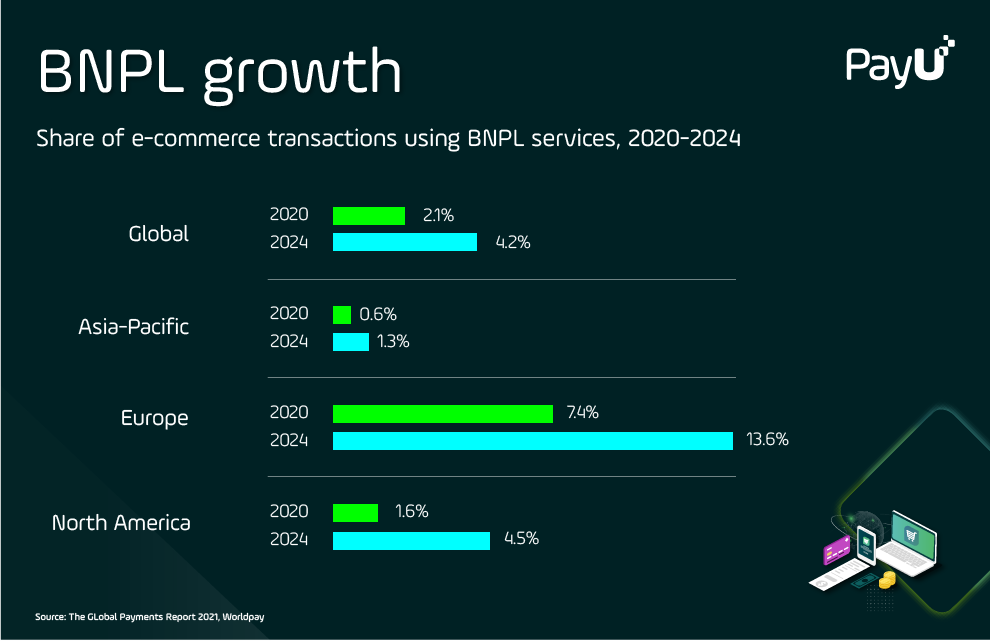
The global BNPL market is expected to achieve a whopping 45.7% CAGR during the current decade, growing from a modest $90.69 billion in 2020 to nearly $4 trillion by 2030. Although the most established BNPL regions are currently Europe and North America, BNPL is also on the rise in emerging markets, where it often serves as a more accessible credit alternative for consumers who lack access to traditional credit cards.

In addition to helping more people around the world to participate in the digital economy, e-commerce merchants benefit from a larger customer base and higher average order values. 

What are some of the other advantages of BNPL? Read on to see how Buy Now Pay Later benefits merchants as well as consumers, and which BNPL payment methods are the most popular across different regions of the world.

Table of Contents

Advantages of Buy Now, Pay Later for merchants

BNPL leaders around the world

BNPL solutions in Europe

Wrap Up: Making the most of BNPL

Advantages of Buy Now, Pay Later for merchants

Buy Now, Pay Later provides a more consumer-friendly way of accessing credit when paying for goods online. Credit decisions are typically made within seconds, with more attainable financing options for a broader range of customers. In many emerging markets, BNPL helps to increase digital and financial inclusion, serving as an alternative credit source for individuals who aren’t covered by traditional financial products or services. 

By increasing buying power, BNPL also boosts the accessibility of e-commerce. Consumers spend 55% more when they can split the payment into installments. 

Merchants offering BNPL and other credit products, meanwhile, benefit from increased sales thanks to improved conversions and higher transaction values for certain types of payments. On PayU’s payment platform, transaction values in markets with installment payments are up to 10 times higher than for other payment methods. 

It’s simple. Customers feel more comfortable making larger purchases online because they can use a secure repayment option. Meanwhile, sellers are paid out for the entire payment amount at the time of purchase, eliminating any credit risk from the merchant perspective.

That’s why more and more merchants are bringing BNPL onboard as a payment method –  building a competitive advantage by making a wider range of products more affordable to the widest possible range of consumers.
BNPL leaders around the world

BNPL solutions in Europe

BNPL is becoming increasingly popular across the entire continent, driven by the media coverage of high profile IPOs, massive homegrown players like Klarna, and double-digit e-commerce expansion in the fast-growing consumer markets of Eastern Europe.

The European BNPL market will grow to nearly $350 billion by 2025 – amounting to approximately 30% of projected e-commerce spending.

Here are some of the top European BNPL providers:

  • Klarna. Swedish fintech Klarna is the largest BNPL player in Europe. Recently valued at $31 billion, Klarna is offered as a payment method by 250.000 merchants and is used by an estimated 90 million consumers across nearly 40 global markets. 
  • PayPal. The longtime e-wallet leader stepped into the BNPL scene in late September 2020, but it’s already catching up quickly with the market thanks to integrations with major platforms like eBay. PayPal was the most downloaded app in Europein 2020 and is sure to remain a fixture in the BNPL space going forward.  
  • Divido. This smart retail finance platform lets consumers spread the cost of their purchases while merchants receive money as the order is shipped. Divido allows its customers to white-label its technology so merchants can add their unique branding to this extra feature in their checkout experience.
  • PayU Credit. The largest online credit broker and distribution platform on the Polish e-commerce scene, PayU Credit facilitates $1 billion in credit volumes across Poland, the Czech Republic, and Romania. Over 2,500 partner merchants use PayU Credit and can reap the benefits of extending a wider range of credit options to online consumers.
  • TwistoPay. TwistoPay is a popular BNPL provider across the CEE region – specifically in Poland and the Czech Republic, with further expansion planned soon to Romania. Twisto allows customers to pay in anywhere between 3 and 12 installments (with low interest) or within 14 days without any commission or additional costs.
  • PayU Installments. PayU’s installment service is part of the PayU Credit offering and is available free of charge to merchants in Poland, the Czech Republic, and Romania. In partnership with the Romanian marketplace eMAG, PayU recently launched a new installment offering called SLICE IT where consumers can pay in four installments spread across three months.
Infographic showing BNPL e-commerce market share in different regions of the world

Wrap Up: Making the most of BNPL

With Buy Now Pay Later becoming increasingly popular as an alternative payment method around the world, a wide range of established players and new BNPL startups have emerged to fulfill the demand.

For merchants interested in offering BNPL across multiple global markets, choosing the right BNPL provider – or working individually with multiple BNPL services – can be a challenging proposition. The alternative is to choose a payment provider with the capability to enable both global as well as specific-to-market BNPL payment method options in different geographies.

Offering a combination of homegrown BNPL offerings as well as connections to local banks and alternative payment methods around the world, PayU provides merchants with the capability to offer a wide range of BNPL options and other payment methods at checkout.

As BNPL continues to increase its market share within the payment landscape, merchants should take note – and look for a global payment solution that can keep up with the trends.

FAQs (6)

What is Buy Now, Pay Later (BNPL)?

BNPL, an alternative payment option, enables customers to initially cover a minor portion of the total purchase cost and pay the remaining balance through installments over a specified period. It is a fast-growing online payment method that increases buying power and makes e-commerce more accessible.

What are the advantages of BNPL for merchants?

Merchants offering BNPL benefit from increased sales, improved conversion rates, higher transaction values, and a larger customer base. They also receive the entire payment amount at the time of purchase, eliminating credit risk from their perspective.

Which regions currently have the most established BNPL markets?

Europe and North America are currently the most established BNPL regions. However, BNPL is also on the rise in emerging markets, where it serves as a more accessible credit alternative for consumers who lack access to traditional credit cards.

How is BNPL expected to grow in the coming years?

The global BNPL market is expected to achieve a 45.7% CAGR during the current decade, growing from $90.69 billion in 2020 to nearly $4 trillion by 2030.

How can merchants choose the right BNPL provider for their business?

Merchants can choose the right BNPL provider by considering their target markets and working with a payment provider like PayU, which can enable global and specific-to-market BNPL payment method options in different geographies.

How do consumers benefit from using BNPL services?

Consumers benefit from BNPL services by having more possible financing options for a broader range of purchases. This allows them to manage their expenses better, access credit more easily, and actively participate in the digital economy.

1